
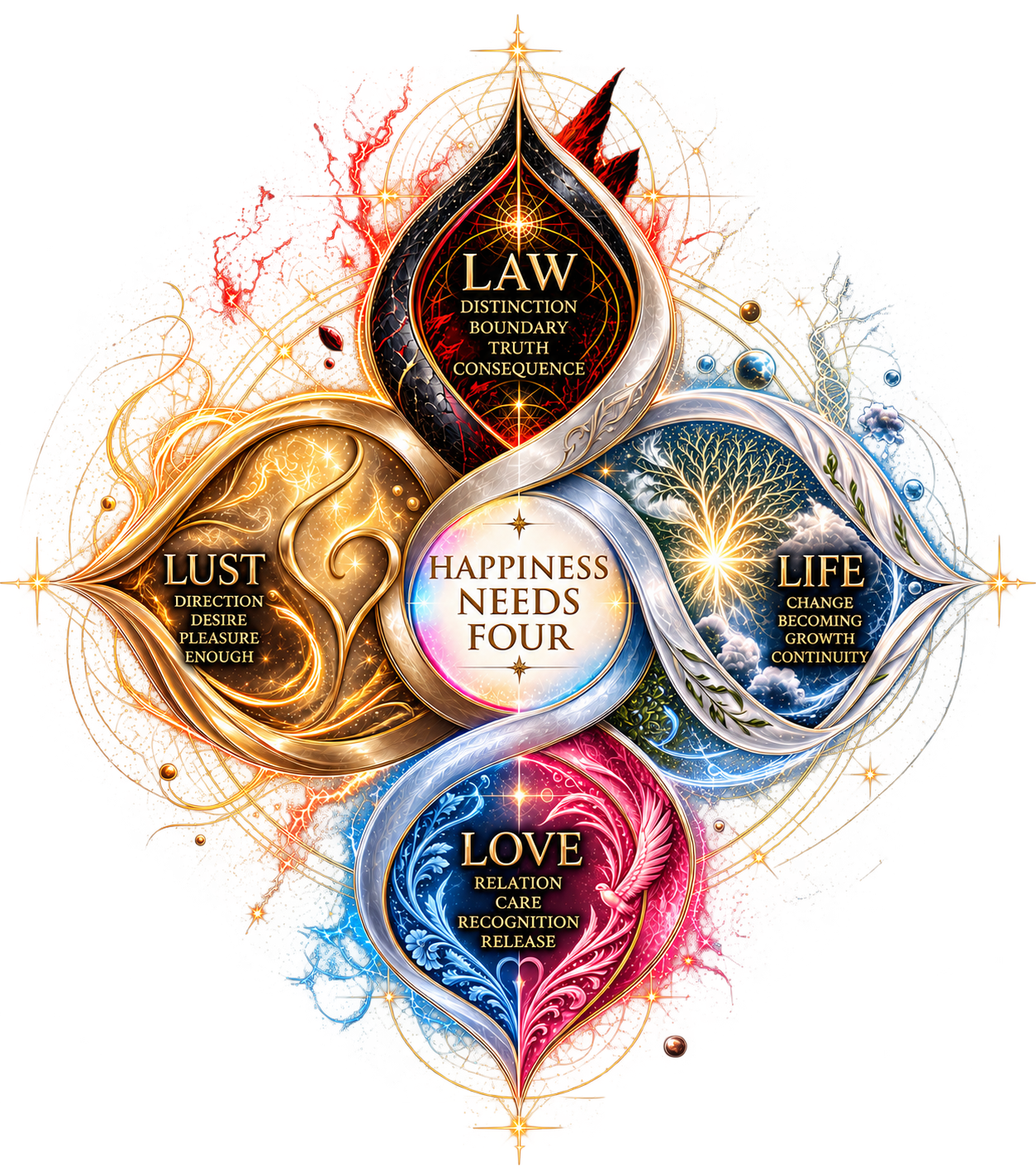
Void Maiden · LAW
What is true, and what boundaries matter?
the facts, distinctions, boundaries, structures, and consequences that give a situation an honest shape.
Meet Void MaidenMUSIC · MYTH · PHILOSOPHY
Maidenism is a philosophy expressed through music, myth, and art. At its heart is the Quaternity: Law, Life, Love, and Lust, explored through Void Maiden, Star Maiden, Love Maiden, and Scar Maiden.
The philosophy
Maidenism is a philosophy expressed through music, myth, and art. It centers on four divine Maidens and the Offices they bear: Void bears Law and gives Form; Star bears Life and gives Change; Love bears Love and gives Relation; Scar bears Lust and gives Direction.
The Maidens give these ideas faces, voices, relationships, and consequences. It is a way to meet a choice, a relationship, a limit, a beginning, or an ending without asking one concern to speak for everything else.
The Four are not personality types, a scorecard, or a demand to explain every event. They are a shared language for noticing what is wanted, what is true, what can change, and what needs care or release.
The Maidens can be approached through art, philosophy, or personal spiritual meaning. The Four remain available to one another, so a plan can be revised when a person, a fact, a consequence, or a relationship calls for another answer.
The Four Offices
Law gives distinction. Life gives change. Love gives relation. Lust gives direction.
Each Office has a necessary question. None is a substitute for the others: a desire does not settle consent, a rule does not settle care, a possibility does not require action, and care does not remove another person’s will.
Void Maiden · LAW
the facts, distinctions, boundaries, structures, and consequences that give a situation an honest shape.
Meet Void MaidenStar Maiden · LIFE
the becoming, growth, adaptation, continuation, and endings through which life does not remain still.
Meet Star MaidenLove Maiden · LOVE
the bonds, recognition, care, responsibility, grief, repair, and release that arise between lives.
Meet Love MaidenScar Maiden · LUST
the desire, attraction, aversion, pleasure, refusal, purpose, and sense of enough that orient choice.
Meet Scar MaidenHappiness Needs Four
In Maidenism, Happiness is not constant pleasure or forced positivity. It is the condition in which desire, truth, possibility, and relation can all matter without one taking the throne.
Happiness does not promise an easy answer, equal emphasis in every moment, or that every wish is granted. It asks whether the answer can remain truthful to the people and consequences involved, including the possibility that enough, a boundary, rest, repair, or an ending is right.
The basic practice
Each Maiden may tell the truth without deciding the whole question. Desire is not permission. A rule is not automatically righteous. Possibility is not obligation. Care is not ownership.
Start where the situation speaks. There is no mandatory first Maiden.
Scar · Lust
Void · Law
Star · Life
Love · Love
For a freely chosen beginning, one useful path is Want → Shape → Become → Tend or release → Choose again.
Being heard is not being obeyed. Hearing all Four means each concern is allowed to matter. It does not mean every demand is satisfied.
A person may hear a desire and decline to act on it. A boundary may be challenged without being ignored. A change may be possible without being required. Care may include distance, accountability, rest, or release.
Open and Kept
The situation can still respond truthfully.
Nothing may change, yet everything must continue.
Open does not mean limitless choice. A hard no can remain Open when its purpose, limits, review, and effects on the people involved can still be named. Keeping begins when the arrangement becomes its own reason and relevant truth, change, harm, or refusal is forbidden from altering it.
The ethical floor
These commitments are not rewards for getting the Four “right.” They are a floor for how the framework is practiced: no sacred language excuses coercion, contempt, falsehood, neglect, or the treatment of a person as a means.
Bodies, consent, truth, material reality, and consequences matter.
People may change, rest, recover, adapt, and name themselves.
Care must not become possession or compulsory self-erasure.
Desire may speak without becoming entitlement.
Choose your path
Start with the question in front of you. The deeper pages remain available when a lived situation needs more history, distinctions, or examples.