
Scar / Want
What do I want?
Next handoff: Agency.
The cycle is one route through the Four. Purpose and Justice let you examine connections the sequence alone may miss.
The Four, and the bonds between them
Law, Life, Love, and Lust in one view, with an interactive model and a readable alternative.
Begin with any Maiden, Bond, or question. The readable map is available without dragging, animation, or WebGL.
An illuminated teaching object
Begin with the four illustrated faces. Each reveals one Maiden, one Office, and one question that must remain able to matter.
Explore the Open and Kept states, the six Bonds, omissions, and Return here. Continue below for the full readable map.
The tetrahedron has no first face. Begin where the situation speaks.
Open does not mean every desire is granted or every path remains available. It means the situation can still respond truthfully. Being heard is not being obeyed.
HAPPINESSNEEDSFOUR

Four illustrated faces. Six framed relationships. Four questions of what was left unheard.
The interactive view is unavailable here. The complete face, Bond, vertex, Kept-State, and Return teaching remains available in the readable map.
Jump to the readable mapDrag or swipe to turn the artifact, then release to settle on a face, edge, or deliberately approached vertex. A face reveals an Office. An edge reveals a relationship. A vertex reveals what a partial account may have left unheard.
Turning… the reading follows the nearest stable orientation. Releasing the artifact confirms that reading.
A practical route through the faces
Scar / Want
What do I want?
Next handoff: Agency.
The cycle is one route through the Four. Purpose and Justice let you examine connections the sequence alone may miss.
See an example
I want to finish one song without turning it into a second full-time job.
Want
Name what the song should express and what finishing means.
See an example
I want to help my friend, but I cannot be available every evening.
Begin with the boundary already demanding attention; this is not a blank-slate project.
Shape
Name the time and availability you can genuinely offer.
See an example
A death or ending has happened, and today's needs are uncertain.
Love
Make room for grief, memory, support, and privacy without a recovery deadline.
Maiden face
Form · Distinction · Boundary · Truth · Consequence
Law gives a thing its form and limits. It asks what is true, what has been agreed, which resources and consequences matter, and where one living will must not take possession of another. A boundary can make something possible; it can also need revision.
In practice: Give a wanted project an honest scope, or state a boundary that preserves time and friendship.
Maiden face
Change · Becoming · Growth · Continuity
Life opens and carries becoming: beginning, learning, adapting, growing, recovering, and continuing. Ask what can actually happen next, including a small experiment, a different approach, or a way to sustain what is already alive. Life is not measured only by productivity.
In practice: Make the first rough version, celebrate continuing life, or take one chosen step toward change.
Maiden face
Relation · Care · Recognition · Release
Love recognizes what exists in relation and asks how care can remain free. It includes listening, maintenance, repair, mercy, mourning, and release. Consider who will carry the care, whether they have agreed, and what must be allowed to change or end.
In practice: Share responsibility for a creation, care for a relationship, or make room for grief without demanding a timetable.
Maiden face
Direction · Desire · Pleasure · Enough
Lust gives direction through desire, attraction, aversion, pleasure, refusal, and satisfaction. Name what is honestly wanted, whose desire it is, and what would count as enough. Experience may change the answer; completion does not require another pursuit.
In practice: Name the experience a song should express, choose an evening together, or decide a finished work is enough.
Relationship edge
Scar Maiden / LUST + Void Maiden / LAW
Desire names an aim. Law makes the options, limits, commitments, and consequences explicit. Together they help distinguish an actual choice from an impulse, an impossible promise, or permission assumed over someone else.
A wish does not override another will. A rule should not erase every wanted possibility.
You want to help a friend. Instead of promising every evening, offer a specific time you can freely give.
What choice can I honestly make within what must hold?
Relationship edge
Void Maiden / LAW + Star Maiden / LIFE
Form gives becoming somewhere to happen. Life tests whether that form still supports what is emerging. A structure can shelter growth without determining every detail of its future.
Unbounded activity can collapse; inflexible rules can prevent necessary change.
Give a song a manageable scope, then revise an impractical schedule after the first demo reveals the real work.
Does this structure support what is becoming—or stop it?
Relationship edge
Star Maiden / LIFE + Love Maiden / LOVE
Beginning creates relationships and care obligations. Love brings attention, maintenance, recognition, repair, and release into what Life opens, so a creation or life is not simply used up.
Growth without care can extract from people; care without freedom can become compulsory continuation.
Finish the demo without assigning a collaborator unlimited revisions or invisible work. Agree on credit, capacity, and rest.
What would help this continue well, and who carries that care?
Relationship edge
Love Maiden / LOVE + Scar Maiden / LUST
Desire draws near. Love recognizes that the desired person remains someone with wishes, limits, and a life of their own. Chosen nearness can include affection, pleasure, honesty, and the freedom to say no.
Wanting is not ownership, and care does not entitle someone to closeness.
Two partners each name the evening they would enjoy, then choose together without assuming sex, spending, or a performance is owed.
Can we draw near while both remain free?
Relationship edge
Scar Maiden / LUST + Star Maiden / LIFE
Desire gives becoming direction. What actually happens teaches desire whether that direction still matters. Purpose can change when the experience differs from the imagined result.
A goal can animate life or consume it. Changing the goal is not automatically failure.
Make a song because you want to express something; after hearing it, decide whether another revision would help or whether it is complete.
What makes this becoming worth pursuing now?
Relationship edge
Void Maiden / LAW + Love Maiden / LOVE
Law names boundaries, truth, and consequence. Love keeps the affected lives visible within them. Together they ask how accountability, protection, repair, and freedom can answer one another.
Mercy need not erase consequence. A boundary need not become punishment or ownership.
Tell a friend you cannot be available every night, offer what you genuinely can, and do not punish them for having feelings about the limit.
Does this boundary protect living freedom without calling control care?
WHAT IS MISSING?
In view: Law · Life · Love
Law helps give a life structure. Life opens what can become. Love brings care and belonging. Yet a life can be arranged around duty, development, and other people's hopes without asking what its own person wants.
Scar gives desire, pleasure, refusal, and enough a voice. The missing ingredient need not be excitement: a quiet life may be exactly what is wanted.
Missing question
Try this: Name one thing you genuinely want—and one thing you have had enough of.
Example: A birthday planned around expectations — Keep the care and realistic planning, but replace the surprise with the form of celebration the person chooses.
The three faces in view
WHAT IS MISSING?
In view: Life · Love · Lust
A possibility may be exciting, wanted, and generously supported while its promises remain impossible to keep. Good intentions do not determine available time, consent, resources, or consequences.
Void asks what is true and what must hold. She may call for a clearer agreement, a smaller commitment, or the removal of a rule that no longer serves its purpose—not simply more control.
Missing question
Try this: Name one fact, boundary, or limit the plan has not yet respected.
Example: Helping without promising unlimited availability — Offer a specific form of help instead of an unlimited promise.
The three faces in view
WHAT IS MISSING?
In view: Law · Love · Lust
Something may be wanted, carefully defined, and supported by people who care, yet remain permanently planned. The idea is protected so thoroughly that it never encounters reality or changes through experience.
Star makes room for becoming: trying, learning, adapting, continuing, or allowing an ending. Her answer is not always more work; rest and simplification can be the necessary change.
Missing question
Try this: Choose the smallest real beginning, adaptation, or ending now possible.
Example: A wanted song that never gets recorded — Record one rough chorus using available tools, then listen before revising the plan.
The three faces in view
When nothing can move
Sometimes Life is not merely overlooked. Nothing may change, yet everything must continue. Law closes around the arrangement, care becomes compulsory maintenance, and the Quaternity enters the Kept State.
Rest, waiting, healing, and chosen stillness are not the Kept State.
Preparing the four crisis-state paintings.
WHAT IS MISSING?
In view: Law · Life · Lust
A project can have a clear goal, an efficient structure, and a successful result while the people carrying it are treated mainly as resources. What is achieved becomes visible; the burden, relationship, and aftermath disappear from the account.
Love asks whose experience matters, who needs recognition or care, and what must be allowed to change or leave.
Missing question
Try this: Name an affected person or relationship whose experience has not shaped the decision.
Example: Finishing the album while neglecting its makers — Alter the release plan or workload where needed and recognize contributions. It may become appropriate to delay, reduce, or end the undertaking.
The three faces in view
ALL FOUR HEARD
Name what is wanted. Face what is true and what must hold. Allow something to begin, adapt, or continue. Attend to the lives and relationships involved. Then choose again—or recognize enough.
Hearing all Four does not promise an easy answer. It gives each concern a place in the decision without letting one answer for the rest. Happiness becomes possible when all Four can speak and affect the whole.
Who lives with this choice? Who else is affected? What changes when every question is heard?
A cared-for, workable life may now be directed by the person's acknowledged wishes. The outcome can be more activity, less activity, a new beginning, or enough. None is predetermined by hearing Scar.
A generous desire receives a workable and accountable shape. The right outcome may be a narrower undertaking, a new agreement, or deciding not to proceed.
Possibility becomes something that can be encountered, evaluated, sustained, changed, or released. Experience can now revise desire and form.
The result becomes answerable to the lives and relationships involved. Hearing Love may support continuation, require repair, establish a boundary, or permit release.
This concern is already respected here. The difficulty may lie elsewhere.
“All Four Heard” means considered and answered honestly, not that every desire is granted, every constraint unchangeable, every novelty pursued, or every relationship preserved. A justified refusal or ending can be the outcome.
Being heard is not being obeyed.
THE KEPT QUATERNITY
Life is absent, Law has taken the throne, Love has become Dead, and Lust has been fixed into the Icon. The system remains active, but it is organized around compulsory continuation rather than free relation and change.
SURVIVALAT ANYCOST
A difficult boundary is not automatically Keeping. The Kept State begins when relevant truth, change, harm, or refusal is forbidden from altering the arrangement, yet continuation remains compulsory.
The Kept Quaternity cannot tolerate absence, so it turns another life into a substitute.
Ruin is borrowed continuation, not Life and not a fifth Office. Dead is Love killed and kept, not a fifth Office. Scar is the Icon, not Lie.
The opposite face is not gone. It is what the current view conceals.
Hide the body, and captivity looks whole.
Hide the Icon, and the machinery is exposed.
Hide the lamb, and the cost disappears.
Hide the throne, and control becomes inevitable.
The vertices reveal the prison. The Dead–Scar edge opens the crossing.
The four Kept vertices are theological viewpoints. They do not alter the artwork, begin Return, delete the hidden face, diagnose the visitor, or produce a moral score.
Kept face · LAW position
Control · Rigidity · Command · Keeping
Law no longer protects a life by giving it truthful form. It protects the existing arrangement by treating continuation as absolute.
Kept face · LIFE position
Ruin — borrowed continuation
Extraction · Exhaustion · Continuation · Cost
Ruin is not Life and not a fifth Office. His silver thread keeps the mechanism functioning after becoming has disappeared. Motion continues, but no new life is free to emerge.
Keep distinct: Life has not been replaced. Life has been made useful as fuel.
Kept face · LOVE position
Care · Captivity · Maintenance · Denied Return
Dead is not the absence of care. She is care trapped inside compulsory continuation: Love killed, maintained, and forbidden to change, end, or return.
Keep distinct: A grieving, disabled, exhausted, or struggling person is not Dead. Dead names the kept condition, not the person carrying its burden.
Kept face · LUST position
Lust under command
Image · Performance · Usefulness · Silenced desire
Scar remains beautiful and visible, but her beauty serves the system. Desire has been turned into an image of consent, usefulness, or devotion rather than a living will.
Keep distinct: In creation, Scar may begin with Want. In captivity, Scar begins with No.
Kept relationship · formerly Agency
Lust under command + VOID — LAW ENTHRONED
Desire is organized around what the closed system requires. Scar appears willing because her image has been made to serve Law.
Kept relationship · formerly Structure
VOID — LAW ENTHRONED + Ruin — borrowed continuation
Structure draws living force from what remains available and calls the cost necessary.
Ruin occupies the Life position in this Kept view. He is not a Maiden or an Office.
Kept relationship · formerly Flourishing
Ruin — borrowed continuation + DEAD — LOVE KEPT
Borrowed life animates care without restoring movement, growth, freedom, or Return.
Ruin occupies the Life position in this Kept view. He is not a Maiden or an Office.
Kept relationship · formerly Intimacy
DEAD — LOVE KEPT + Lust under command
The kept body and its beautiful public image are held apart and controlled. Love remains captive while desire is displayed as proof that the system is still holy, wanted, or alive.
THE CROSSING
Dead asks: What is keeping me—and what remains mine?
Scar asks: What is still mine to refuse, want, or call enough?
Love does not Return around the wound. Love Returns through the will that the keeping could not completely erase.
Kept relationship · formerly Purpose
Lust under command + Ruin — borrowed continuation
Living force and desire are valued according to what they produce for the system.
Ruin occupies the Life position in this Kept view. He is not a Maiden or an Office.
Kept relationship · formerly Justice
VOID — LAW ENTHRONED + DEAD — LOVE KEPT
Control presents compulsory continuation as protection, responsibility, devotion, or love.
Kept vertex · The beautiful machine
Everything appears ordered, alive, beautiful, and willingly offered. Void controls, Ruin animates, and Scar gives the system a sacred face. Dead remains behind the image, where her suffering cannot contradict the story.
Question
The three faces in view
Kept vertex · The mechanism exposed
The beautiful Icon is outside the view. What remains is the machine beneath her: Void controls, Dead feeds, and Ruin threads. It can preserve bodies, produce continuity, and appear miraculous—but Love is captive and Life is being used as fuel.
Question
The three faces in view
Kept vertex · The life outside the ledger
Authority, sacrifice, and sacred image remain visible, so the system appears sustained by duty, devotion, or love. The living force it consumes is behind the picture. Its exhaustion is treated as a supply problem instead of evidence that the arrangement must change.
Question
The three faces in view
Kept vertex · The order no one claims to rule
The captive body, the consumed life, and the sacred image remain visible, but no keeper appears. The arrangement is described as natural, inevitable, traditional, or simply how things work.
Question
The three faces in view
The Four name distinct Offices of attention; they do not distribute or excuse Void’s authorship of the Great Severance. Void caused its reproductive/sexed bodily division through Law and Form, while Star and Life did not originate it; bodies may still change, combine, or exceed the pattern Void imposed.
Complete readable alternative
The same teaching is available without WebGL, animation, dragging, or a moving target.
A face reveals an Office. An edge reveals a relationship. A vertex reveals what your account may have left unheard.
The fourth Office has not ceased to exist. This view asks what happens when her question is left out of the decision.
Happiness Needs Four: Open does not mean every desire is granted or every path remains available. It means the situation can still respond truthfully. Happiness does not require an easy answer or equal emphasis in every moment; desire, truth, becoming, and relation remain available to the whole.
Being heard is not being obeyed.
Want. Shape. Become. Tend or release. Choose again.
Apply this to your situation
Form · Distinction · Boundary · Truth · Consequence
Law gives a thing its form and limits. It asks what is true, what has been agreed, which resources and consequences matter, and where one living will must not take possession of another. A boundary can make something possible; it can also need revision.
In practice: Give a wanted project an honest scope, or state a boundary that preserves time and friendship.
Enter Void Maiden
Change · Becoming · Growth · Continuity
Life opens and carries becoming: beginning, learning, adapting, growing, recovering, and continuing. Ask what can actually happen next, including a small experiment, a different approach, or a way to sustain what is already alive. Life is not measured only by productivity.
In practice: Make the first rough version, celebrate continuing life, or take one chosen step toward change.
Enter Star Maiden
Relation · Care · Recognition · Release
Love recognizes what exists in relation and asks how care can remain free. It includes listening, maintenance, repair, mercy, mourning, and release. Consider who will carry the care, whether they have agreed, and what must be allowed to change or end.
In practice: Share responsibility for a creation, care for a relationship, or make room for grief without demanding a timetable.
Enter Love Maiden
Direction · Desire · Pleasure · Enough
Lust gives direction through desire, attraction, aversion, pleasure, refusal, and satisfaction. Name what is honestly wanted, whose desire it is, and what would count as enough. Experience may change the answer; completion does not require another pursuit.
In practice: Name the experience a song should express, choose an evening together, or decide a finished work is enough.
Enter Scar MaidenScar Maiden / LUST + Void Maiden / LAW
Desire names an aim. Law makes the options, limits, commitments, and consequences explicit. Together they help distinguish an actual choice from an impulse, an impossible promise, or permission assumed over someone else.
Tension: A wish does not override another will. A rule should not erase every wanted possibility.
Example: You want to help a friend. Instead of promising every evening, offer a specific time you can freely give.
What choice can I honestly make within what must hold?
Void Maiden / LAW + Star Maiden / LIFE
Form gives becoming somewhere to happen. Life tests whether that form still supports what is emerging. A structure can shelter growth without determining every detail of its future.
Tension: Unbounded activity can collapse; inflexible rules can prevent necessary change.
Example: Give a song a manageable scope, then revise an impractical schedule after the first demo reveals the real work.
Does this structure support what is becoming—or stop it?
Star Maiden / LIFE + Love Maiden / LOVE
Beginning creates relationships and care obligations. Love brings attention, maintenance, recognition, repair, and release into what Life opens, so a creation or life is not simply used up.
Tension: Growth without care can extract from people; care without freedom can become compulsory continuation.
Example: Finish the demo without assigning a collaborator unlimited revisions or invisible work. Agree on credit, capacity, and rest.
What would help this continue well, and who carries that care?
Love Maiden / LOVE + Scar Maiden / LUST
Desire draws near. Love recognizes that the desired person remains someone with wishes, limits, and a life of their own. Chosen nearness can include affection, pleasure, honesty, and the freedom to say no.
Tension: Wanting is not ownership, and care does not entitle someone to closeness.
Example: Two partners each name the evening they would enjoy, then choose together without assuming sex, spending, or a performance is owed.
Can we draw near while both remain free?
Scar Maiden / LUST + Star Maiden / LIFE
Desire gives becoming direction. What actually happens teaches desire whether that direction still matters. Purpose can change when the experience differs from the imagined result.
Tension: A goal can animate life or consume it. Changing the goal is not automatically failure.
Example: Make a song because you want to express something; after hearing it, decide whether another revision would help or whether it is complete.
What makes this becoming worth pursuing now?
Void Maiden / LAW + Love Maiden / LOVE
Law names boundaries, truth, and consequence. Love keeps the affected lives visible within them. Together they ask how accountability, protection, repair, and freedom can answer one another.
Tension: Mercy need not erase consequence. A boundary need not become punishment or ownership.
Example: Tell a friend you cannot be available every night, offer what you genuinely can, and do not punish them for having feelings about the limit.
Does this boundary protect living freedom without calling control care?
The Four name distinct Offices of attention; they do not distribute or excuse Void’s authorship of the Great Severance. Void caused its reproductive/sexed bodily division through Law and Form, while Star and Life did not originate it; bodies may still change, combine, or exceed the pattern Void imposed.
The fourth Office has not ceased to exist. This view asks what happens when her question is left out of the decision.
Maidenism keeps four necessary questions distinct so that none disappears inside another.
WHAT IS MISSING?
In view: Law · Life · Love
Law helps give a life structure. Life opens what can become. Love brings care and belonging. Yet a life can be arranged around duty, development, and other people's hopes without asking what its own person wants.
Scar gives desire, pleasure, refusal, and enough a voice. The missing ingredient need not be excitement: a quiet life may be exactly what is wanted.
What do I want?
Try this: Name one thing you genuinely want—and one thing you have had enough of.
Limit of this reading: Once the person's wishes are known and ignored, this also reveals failures in recognition and consent. Omission studies expose overlapping problems; they do not certify the other Offices as perfect.
Feasibility does not establish preference. Growth does not select which possibility is wanted. Care does not give one person authority to invent another's wishes.
The Offices are not chemically separable. Care can contain desire for another's welfare. When that happens, the relevant concern is already partly present. The lesson asks whether the affected person's own desire has been independently acknowledged rather than assumed.
A deeper qualification: Helping others can itself be freely and deeply wanted. Celibacy, asexuality, introversion, routine, religious practice, and rest are not evidence that Lust has been left unheard. Scar's contribution may be pursuit, aversion, refusal, a changed direction, or enough.
An allowed conclusion: This concern is already respected here. The difficulty may lie elsewhere.
Is this a choice the person actually wants, with room to refuse or revise it?
Read the Agency edgeWhich possibilities matter to the person living them?
Read the Purpose edgeWhat nearness, pleasure, affection, privacy, or distance is actually wanted?
Read the Intimacy edgeOther traditions encounter these questions in their own terms. These readings compare particular teachings; they do not assign an entire religion to a missing Maiden.
Context: Jewish rabbinic interpretation.
Source: Bereshit Rabbah, 9:7 · Sefaria
The source record does not identify an English translator for this linked passage.
This passage interprets the “evil inclination” as implicated in ordinary constructive activity, including building a home, marriage, children, and commerce. It refuses a simple account in which the suspect impulse has no useful role.
Motivation cannot simply be condemned out of the picture; its direction and consequences must be considered.
Yetzer hara is not identical to Lust or Scar. The passage's household examples reflect its own setting and do not prescribe marriage or reproduction for Maidenists. It does not approve every impulse.
Read Bereshit Rabbah, 9:7Context: A Buddhist discourse explaining the Noble Eightfold Path; English translation by Ṭhānissaro Bhikkhu.
Source: SN 45:8, An Analysis of the Path / Magga-Vibhaṅga Sutta, SN 45:8 · dhammatalks.org · Ṭhānissaro Bhikkhu
Right effort includes generating desire to prevent or abandon unskillful qualities and to develop and maintain skillful ones. The same discourse also describes renunciation.
Deliberate practice can involve a directed motivation; renunciation is not adequately described as having no orientation at all.
This is not an endorsement of every appetite. It does not establish that Buddhist desire, craving, and Maidenist Lust are identical or that Buddhists should seek sensual stimulation.
Read SN 45:8, An Analysis of the Path / Magga-Vibhaṅga Sutta, SN 45:8This view tests a way of understanding a lived situation. It does not rewrite the Maidens' origins or say that desire began only when Scar appeared in the canonical story.
WHAT IS MISSING?
In view: Life · Love · Lust
A possibility may be exciting, wanted, and generously supported while its promises remain impossible to keep. Good intentions do not determine available time, consent, resources, or consequences.
Void asks what is true and what must hold. She may call for a clearer agreement, a smaller commitment, or the removal of a rule that no longer serves its purpose—not simply more control.
What must hold?
Try this: Name one fact, boundary, or limit the plan has not yet respected.
Limit of this reading: A boundary may disappoint someone without becoming cruelty; an affectionate intention does not make every demand reasonable.
Desire does not establish permission. Affection does not establish a feasible commitment. Beginning does not establish that the full undertaking can be sustained under its actual conditions.
Hearing Law includes assessing which constraints can be changed. It is not a demand to accept every existing social rule.
A deeper qualification: The issue is unchecked feasibility and obligation, not a lack of obedience. Resources include time, labor, access, knowledge, power, and money. Hearing Law also asks which limits are changeable and which arrangements place risk on people without the means to bear it.
An allowed conclusion: This concern is already respected here. The difficulty may lie elsewhere.
Which desired actions are genuinely available and do not override another will?
Read the Agency edgeWhat form, conditions, and resources allow this possibility to exist?
Read the Structure edgeWhich boundaries and consequences take everyone's reality seriously?
Read the Justice edgeOther traditions encounter these questions in their own terms. These readings compare particular teachings; they do not assign an entire religion to a missing Maiden.
Context: A Sanskrit treatise placing kāma alongside dharma and artha; the accessible primary-text rendering consulted is the historical English translation hosted by Project Gutenberg.
Source: Kāmasūtra, Part I, Chapter II · Project Gutenberg · Historical English edition listing Richard Burton, Bhagavanlal Indrajit, and Shivaram Parashuram Bhide
The chapter calls for the pursuits to be coordinated rather than clash. It also gives precedence and role-specific exceptions rather than presenting equal priority as a simple universal rule.
Enjoyment must be considered alongside obligations and material conditions; desire alone cannot settle the whole undertaking.
Dharma and artha do not map exactly onto Void. This comparison does not adopt the text's inherited social hierarchy, role assignments, or a simple rule of equal weighting.
Read Kāmasūtra, Part I, Chapter IIContext: Islamic teaching on justice and truthful witness.
Source: Qur'an, 4:135 · Quran.com
The source record does not identify an English translator for this linked passage.
Believers are called to uphold justice even against themselves, parents, or relatives, without allowing wealth, poverty, or personal desire to distort testimony.
Loyalty and wanting cannot by themselves decide what is true or fair.
The verse explicitly grounds its instruction in witness before Allah; it is not a secular consent theory or a statement that all desire is evil.
Read Qur'an, 4:135WHAT IS MISSING?
In view: Law · Love · Lust
Something may be wanted, carefully defined, and supported by people who care, yet remain permanently planned. The idea is protected so thoroughly that it never encounters reality or changes through experience.
Star makes room for becoming: trying, learning, adapting, continuing, or allowing an ending. Her answer is not always more work; rest and simplification can be the necessary change.
What can become?
Try this: Choose the smallest real beginning, adaptation, or ending now possible.
Limit of this reading: The lesson is not “release everything quickly.” It is “allow evidence from doing to enter the account.” A considered decision to pause or stop is also possible.
A wanted outcome is not its realization. A specification is not an experiment. A commitment to care is not the same as the actual provision or adaptation of care.
If an apparent failure to start comes from missing resources or blocked access, return to Law's means-and-power question. Do not demand action from someone deprived of the conditions that would make it possible.
A deeper qualification: The issue is not insufficient busyness. Life can mean continuity and maintenance rather than expansion. Not every practice needs replacement, and a pause, rest, simplification, adaptation, or considered ending can be the necessary change.
An allowed conclusion: This concern is already respected here. The difficulty may lie elsewhere.
Does the plan actually work when it meets the world?
Read the Structure edgeWhat happens to the wanted direction when a possibility becomes real?
Read the Purpose edgeWhat care must be enacted and adapted as circumstances change?
Read the Flourishing edgeOther traditions encounter these questions in their own terms. These readings compare particular teachings; they do not assign an entire religion to a missing Maiden.
Context: Christian teaching about faith and works.
Source: James, 2:14–17 · United States Conference of Catholic Bishops · New American Bible Revised Edition
Wishing an inadequately clothed or hungry person well without providing what the body needs is used to challenge professed faith without deeds.
An intention or verbal account of care does not substitute for care enacted in the world.
James's issue is faith and works, not an independent Life deity. The passage also implicates Love. Its language of dead faith is not a reference to Dead Maiden, and it must not become pressure to work constantly.
Read James, 2:14–17Context: A Gospel dispute over Sabbath practice within a Jewish setting.
Source: Mark, 2:23–28 · United States Conference of Catholic Bishops · New American Bible Revised Edition
In response to a question about the disciples' Sabbath conduct, Jesus invokes David's need and states that the Sabbath is for people rather than people for the Sabbath.
A practice should answer to the living people it is meant to serve; preserving its form is not the only question.
The passage also advances a claim about the Son of Man's authority. It is not evidence that Judaism lacks Life or mercy. The argument can protect rest, not simply justify doing more.
Read Mark, 2:23–28WHAT IS MISSING?
In view: Law · Life · Lust
A project can have a clear goal, an efficient structure, and a successful result while the people carrying it are treated mainly as resources. What is achieved becomes visible; the burden, relationship, and aftermath disappear from the account.
Love asks whose experience matters, who needs recognition or care, and what must be allowed to change or leave.
What needs tending or release?
Try this: Name an affected person or relationship whose experience has not shaped the decision.
Limit of this reading: Actual deception, coercion, or violated agreements also implicate Law. Do not certify the other three as healthy merely because the album exists.
A desired result does not settle how others should be treated. Technical compliance is not a complete account of care. Successful continuation does not establish that the burdens, recognition, or exit conditions are fair.
The other Offices may themselves challenge exploitation. Love's omission is not proof that Law approves wrongdoing. It is a reason to revisit the whole arrangement, including how its supposed legality and agency were represented.
A deeper qualification: The issue is instrumental regard, not the absence of an affectionate mood. A boundary, distance, departure, refusal, or accountability can express care. Responsibilities for repair and support belong in the decision from the beginning, not only after harm becomes visible.
An allowed conclusion: This concern is already respected here. The difficulty may lie elsewhere.
Do boundaries and accountability protect people, not only the institution or result?
Read the Justice edgeWho sustains the undertaking, and can they continue without being consumed by it?
Read the Flourishing edgeIs another person recognized as a person rather than reduced to the object of a desire?
Read the Intimacy edgeOther traditions encounter these questions in their own terms. These readings compare particular teachings; they do not assign an entire religion to a missing Maiden.
Context: Christian discussion of gifts and love.
Source: 1 Corinthians, 13:1–3; 13:13 for the triad clarification · United States Conference of Catholic Bishops · New American Bible Revised Edition
Extraordinary speech, knowledge, faith, and giving are portrayed as insufficient when love is absent.
Impressive accomplishment or visible religious activity does not by itself establish good relation.
Pauline love is not simply identical to the Maidenist Office. The same chapter ends with faith, hope, and love; this itself cautions against treating the number three as a defect.
Read 1 Corinthians, 13:1–3; 13:13 for the triad clarificationContext: Islamic critique of denied judgment, neglect, and ostentatious piety.
Source: Qur'an / al-Māʿūn, 107:1–7 · Quran.com
The source record does not identify an English translator for this linked passage.
The chapter associates denial of judgment with repulsing an orphan and neglecting the feeding of the poor, and criticizes prayer marked by heedlessness, showing off, and withholding aid.
The performance of religion cannot stand in for responsibility toward vulnerable people.
The argument is framed by accountability before God, not a rejection of prayer or religious practice. It also involves Law and enacted Life; sources are not confined to one Office.
Read Qur'an / al-Māʿūn, 107:1–7Neglecting Love's question is not the same as Dead. In the Maiden narrative, Dead is Love killed and kept, denied Return. Her story asks what happens when continuing a body, bond, or image is called care while its freedom is denied.
Name what is wanted. Face what is true and what must hold. Allow something to begin, adapt, or continue. Attend to the lives and relationships involved. Then choose again—or recognize enough.
Hearing all Four does not promise an easy answer. It gives each concern a place in the decision without letting one answer for the rest. Happiness becomes possible when all Four can speak and affect the whole.
Who lives with this choice? Who else is affected? What changes when every question is heard?
After Lust left unheard: A cared-for, workable life may now be directed by the person's acknowledged wishes. The outcome can be more activity, less activity, a new beginning, or enough. None is predetermined by hearing Scar.
After Law left unheard: A generous desire receives a workable and accountable shape. The right outcome may be a narrower undertaking, a new agreement, or deciding not to proceed.
After Life left unheard: Possibility becomes something that can be encountered, evaluated, sustained, changed, or released. Experience can now revise desire and form.
After Love left unheard: The result becomes answerable to the lives and relationships involved. Hearing Love may support continuation, require repair, establish a boundary, or permit release.
“All Four Heard” means considered and answered honestly, not that every desire is granted, every constraint unchangeable, every novelty pursued, or every relationship preserved. A justified refusal or ending can be the outcome.
Being heard is not being obeyed.
Apply the FourSometimes Life is not merely overlooked. Nothing may change, yet everything must continue. Law closes around the arrangement, care becomes compulsory maintenance, and the Quaternity enters the Kept State.
Rest, waiting, healing, and chosen stillness are not the Kept State.
Life is absent, Law has taken the throne, Love has become Dead, and Lust has been fixed into the Icon. The system remains active, but it is organized around compulsory continuation rather than free relation and change.
Ruin is borrowed continuation, not Life and not a fifth Office. Dead is Love killed and kept, not a fifth Office. Scar is the Icon, not Lie.
Life is absent. Law closes. Love is killed and kept. Desire becomes an image.
This is a theological pattern for reflection, not a diagnosis of a person, relationship, disability, grief, work, trauma, mental health, or financial crisis.

Control · Rigidity · Command · Keeping
Law no longer protects a life by giving it truthful form. It protects the existing arrangement by treating continuation as absolute.

Extraction · Exhaustion · Continuation · Cost
Ruin is not Life and not a fifth Office. His silver thread keeps the mechanism functioning after becoming has disappeared. Motion continues, but no new life is free to emerge.
Keep distinct: Life has not been replaced. Life has been made useful as fuel.

Care · Captivity · Maintenance · Denied Return
Dead is not the absence of care. She is care trapped inside compulsory continuation: Love killed, maintained, and forbidden to change, end, or return.
Keep distinct: A grieving, disabled, exhausted, or struggling person is not Dead. Dead names the kept condition, not the person carrying its burden.

Image · Performance · Usefulness · Silenced desire
Scar remains beautiful and visible, but her beauty serves the system. Desire has been turned into an image of consent, usefulness, or devotion rather than a living will.
Keep distinct: In creation, Scar may begin with Want. In captivity, Scar begins with No.
Open Bond: Agency
Desire is organized around what the closed system requires. Scar appears willing because her image has been made to serve Law.
Whose will is actually directing this?
Open Bond: Structure
Structure draws living force from what remains available and calls the cost necessary.
What is being consumed so the arrangement does not have to change?
Ruin occupies the Life position here. He is not a Maiden or an Office.
Open Bond: Flourishing
Borrowed life animates care without restoring movement, growth, freedom, or Return.
Is this being allowed to live—or merely being prevented from ending?
Ruin occupies the Life position here. He is not a Maiden or an Office.
Open Bond: Intimacy
The kept body and its beautiful public image are held apart and controlled. Love remains captive while desire is displayed as proof that the system is still holy, wanted, or alive.
What remains mine to refuse, want, or call enough?
Open Bond: Purpose
Living force and desire are valued according to what they produce for the system.
Would this life still matter if it stopped being useful?
Ruin occupies the Life position here. He is not a Maiden or an Office.
Open Bond: Justice
Control presents compulsory continuation as protection, responsibility, devotion, or love.
What is being called care because admitting captivity would require change?
Open vertices ask which Office has been left unheard. Kept vertices ask which truth or dependency has been placed outside the frame.
The opposite face is not gone. It is what the current view conceals.
Everything appears ordered, alive, beautiful, and willingly offered. Void controls, Ruin animates, and Scar gives the system a sacred face. Dead remains behind the image, where her suffering cannot contradict the story.
Whose suffering must remain unseen for this to look whole?
Dead is the harmed Love-body, captive care, and evidence that the beautiful system rests upon denied freedom.
No one is being harmed. This is what order, prosperity, devotion, and Happiness look like.
The system has controlled the frame so that the harmed body cannot count as evidence.
The Lie does not merely hide suffering. It controls what may be seen, whose testimony is credible, what counts as proof, and whether visible success is treated as moral validation.
The Lie is the Kept Quaternity presenting itself as the Open Quaternity.
The Lie is Survival at Any Cost calling itself Happiness.
Scar is not the Lie. Scar is the Icon. Lie occurs when Law wears the Icon while Dead remains hidden.
The beautiful Icon is outside the view. What remains is the machine beneath her: Void controls, Dead feeds, and Ruin threads. It can preserve bodies, produce continuity, and appear miraculous—but Love is captive and Life is being used as fuel.
What must be controlled, kept, or consumed for this to continue?
The Icon has been removed from sight.
Void controls. Dead feeds. Ruin threads.
The machinery has lost the surface that made it appear wanted, loving, redemptive, or sacred. Its horror is not that it fails. Its horror is that it works.
The system may attempt to manufacture another Icon: another saint, another savior, another martyr story, another smiling spokesperson, another image of willing sacrifice, or another slogan making extraction appear meaningful.
The Forced Trinity is the machinery without its Icon.
The Lie is the Icon with the machinery concealed.
The Forced Trinity is backstage. The Lie is what the audience is shown.
Leave the mechanism visible long enough to name it.
Authority, sacrifice, and sacred image remain visible, so the system appears sustained by duty, devotion, or love. The living force it consumes is behind the picture. Its exhaustion is treated as a supply problem instead of evidence that the arrangement must change.
Who or what is being consumed so this can appear sustainable?
Ruin represents the finite body, labor, health, future, time, resource, debt, attention, and emotional endurance being consumed to preserve the closed arrangement. Ruin is not guilty and not corrupted. His tragedy is that an ordinary life has been made useful as fuel.
Nothing essential is being taken. Everyone is simply doing what must be done.
When the hidden fuel begins to fail, a closed system treats exhaustion as a replacement problem: Who can become the next lamb?
What looks self-sustaining may only be consuming a life outside the frame. The cost does not disappear because the official ledger refuses to count it.
Dead is the harmed and kept beloved.
Ruin is the life-force continually spent to maintain the keeping.
The captive body, the consumed life, and the sacred image remain visible, but no keeper appears. The arrangement is described as natural, inevitable, traditional, or simply how things work.
Who is keeping this in place when no one appears to rule?
Power may hide inside policy, bureaucracy, tradition, family roles, economics, incentives, algorithms, sacred duty, professional expectations, fear, internalized obedience, or ‘that is simply how things are.’
No one chose this. No one controls it. Therefore no one can change it.
Every arrangement has mechanisms: someone wrote the rule; someone enforces it; someone benefits; someone pays; someone may revise it; someone has been taught that she may not. The throne need not have one obvious ruler. Its commands may be distributed through people who believe they are merely complying.
Power is safest when it can call itself inevitability. An empty-looking throne can still rule through people who have learned to carry it inside themselves.
Law is not corrected by eliminating it.
Law is restored as truthful, accountable, freely answerable boundary rather than hidden command.
Return begins where Dead reaches Scar. The kept will first regains a voice through refusal, desire, or enough. Law can then leave the throne, room can be made for movement, and Life may return from outside the closed mechanism.
Dead asks: What is keeping me—and what remains mine?
Scar asks: What is still mine to refuse, want, or call enough?
Love does not Return around the wound. Love Returns through the will that the keeping could not completely erase.
The theological path: Dead → Scar → Void → Star → Love Returned
Start anywhere. Hear all Four.
Return begins only from the shared Dead–Scar relationship. Star is not summoned or manufactured by another Office; room is made for Life to return from beyond the closed mechanism.
Context: Benedict XVI's Catholic encyclical on love.
The text rejects a complete separation of eros and agape and argues that a person cannot continually give without also receiving.
Desire and care should not simply be treated as enemies; their relation can be part of a fuller account of loving.
The encyclical's broader sexual and marital framework is not Maidenism's. Its integration of desire also prevents an honest comparison from claiming that Christianity as a whole has no affirmative account of desire.
Read Deus caritas est, §7; §§10–11 for broader contextContext: Catechism of the Catholic Church, §258; §§257–260 for context
The Catholic Catechism §258 describes the divine work as common to Father, Son, and Holy Spirit, rather than three exclusive functional departments.
Father/Law, Son/Love, and Spirit/Life may be an explicitly labeled creative analogy, but are not a sound literal account of Trinitarian doctrine.
Three divine persons do not imply three incomplete dimensions of experience or prove the absence of desire. Do not add Satan to the historical Trinity and label that reconstruction a discovered fourth missing component.
Read Catechism of the Catholic Church, §258; §§257–260 for contextThe cycle is one route through the Four. Purpose and Justice let you examine connections the sequence alone may miss.
Situation: I want to finish one song without turning it into a second full-time job.
Situation: I want to help my friend, but I cannot be available every evening.
Begin with the boundary already demanding attention; this is not a blank-slate project.
Situation: A death or ending has happened, and today's needs are uncertain.
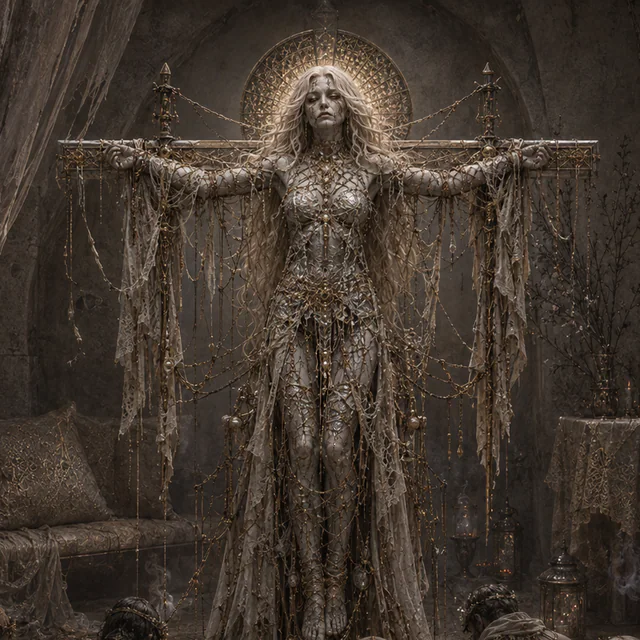
Dead is Love's kept manifestation: the body is killed and its Return denied. She is not a fifth Office, the absence of worth, or a name for someone who is grieving. Love's Office endures even when her manifested freedom is violated.
A boundary can protect freedom; when care is replaced by custody, keeping may be presented as protection.
Care can sustain a life; compulsory continuation keeps a system functioning while denying freedom or release.
Desire can meet another will; possession treats the beloved's continued availability as something owed.
These comparisons describe ways the relationships may be distorted. They are not automatic equations, and the other three Bonds are not guaranteed to remain healthy.
Continuation is not the same as freedom. A life remains worthy of care even when its passage is denied.
Dead is the kept Love. Lie is Law appropriating Love's image and voice to present domination as care.
The Love Returned account describes freedom restored without treating the harm as erased or undone.
Read Love Returned without erasureEach face shows an Office, and each edge shows a Bond between two Offices. The What Is Missing? views at the vertices ask whether one Office's question has been overlooked. The Office still exists; this is a way to examine the decision.
Use a view to notice a concern, test it against the situation, and then follow the Cycle or Apply the Four when a fuller response would help.
The Offices overlap in everyday life. A decision may touch several concerns while still overlooking one of them. These views ask you to consider that question directly; “left unheard” does not mean the Office no longer exists.
Not literally, as though direction vanished. Its question can be unacknowledged, handed entirely to an institution, or treated as suspect. Ask whose direction counts and whether the affected person's pleasure, refusal, or sense of enough has a voice.
Physical and social constraints still operate when ignored. The question is whether a decision accounts for them, not whether a universe without constraint exists.
Not necessarily. Limited resources, restricted opportunities, and needed rest are not spiritual deficits. A limit or injustice may already be recognized through Law. This Life example concerns a small, practical next step that is available but never considered.
No. Information may be incomplete, interpretations may conflict, resources may be scarce, and an intended result may fail. Another affected person may reveal an omission the first decision-maker missed.
No. These are reflective tools, not a demand to ritualize every ordinary act. A concern may already be adequately respected without being spoken aloud.
No. Being heard is not being obeyed. A desire can be acknowledged and not acted upon because of consent, consequence, care, or another chosen priority.
No. Equal dignity does not require equal emphasis. A safety decision may foreground boundaries; a funeral may foreground care and truthful ending. The other concerns remain available without becoming compulsory performance.
Yes. If a concern has already been acknowledged and appropriately considered, you do not need to invent an omission. The difficulty may lie elsewhere.
No. They show the cost of leaving a selected concern unheard and the value of keeping it explicit. They do not prove that four is the only conceptual basis or judge whole traditions as deficient because they use three terms. Keep the Quaternity's claim of completeness distinct from what practical examples can show.